2025 Healthcare AI Revolution: "It Doesn't Replace Doctors, It Gives Them Superpowers"
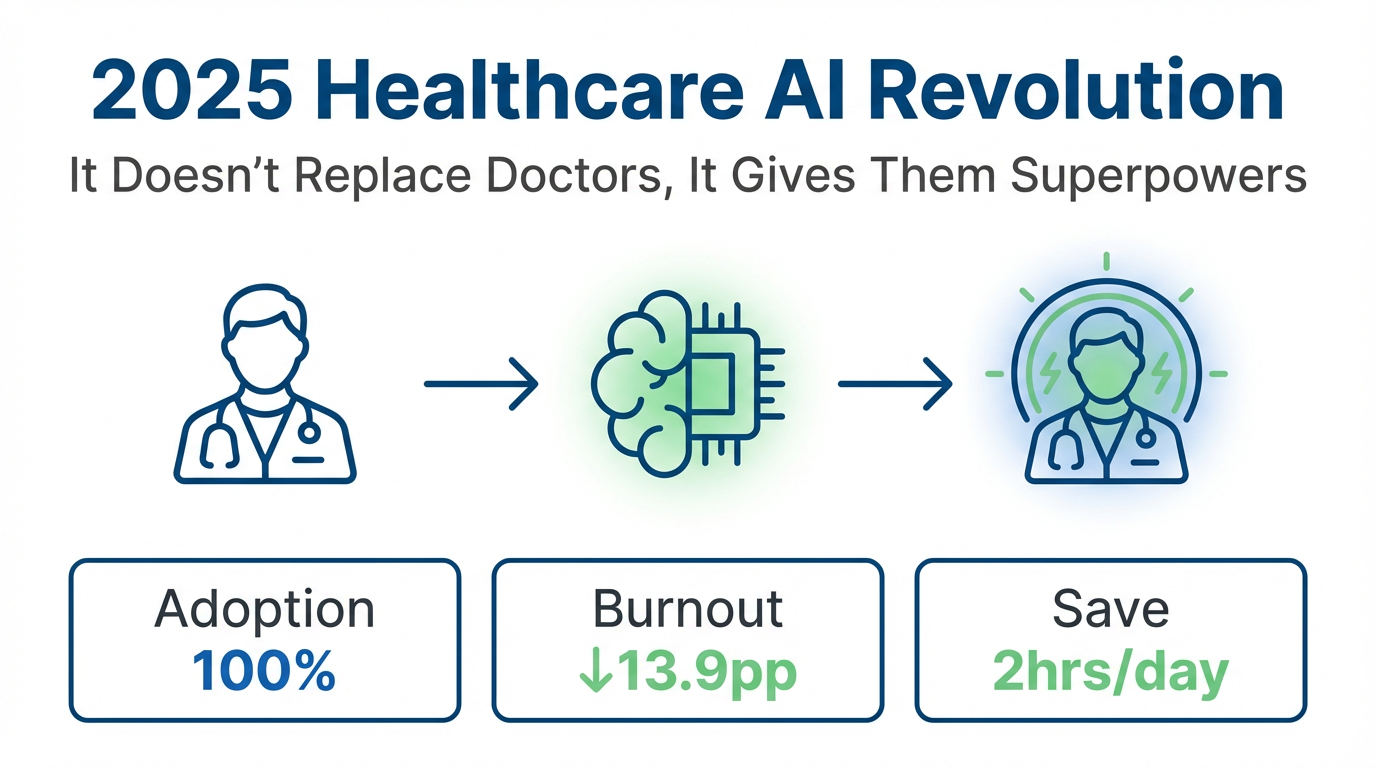
Ambient AI adoption hits 100%, physician burnout drops 13.9 percentage points... Medical practices reclaim 2 hours per day
Ambient AI adoption hits 100%, physician burnout drops 13.9 percentage points... Medical practices reclaim 2 hours per day
[December 28, 2025] Ambient AI adoption rate 100%, physician burnout decreased by 13.9 percentage points, 2 hours saved per day. The changes AI brought to healthcare in 2025 were dramatic.
In 2025, it was nearly impossible to have a conversation about healthcare without discussing artificial intelligence (AI). As AI permeated every corner of medical practice—from clinical documentation to diagnostic assistance and patient financial management—the debate shifted entirely from "Will AI replace doctors?" to "How does AI help doctors?"
According to interviews with industry leaders conducted by Healthcare Brew, a leading U.S. healthcare media outlet, 2025 is being recognized as the year AI moved beyond experimentation to become fully embedded in clinical practice.
Ambient AI Emerges as Healthcare's 'Killer App'
The most striking change has been the explosive adoption of Ambient AI technology. This technology, which listens to doctor-patient conversations in real-time and automatically generates clinical documentation, is now being used to some degree by 100% of U.S. healthcare systems as of 2025.
According to market research firm DemandSage, ambient clinical documentation tools have become the most universally adopted AI use case in healthcare. In fact, 68% of physicians report increased use of AI for clinical documentation, and 72% of AI users rely on it as a core tool.
Nele Jessel, Chief Medical Officer at Athenahealth, emphasized: "2025 was the year we stopped debating whether AI belongs in healthcare and started proving that it does. AI doesn't replace clinicians—it gives them superpowers to focus on what humans do best: connecting, caring, and healing."
2 Hours Reclaimed Daily, Burnout Down 13.9 Percentage Points
The impact of AI has been proven in numbers. According to a survey reported by Fierce Healthcare, physicians using AI save an average of 12 minutes per visit, which translates to approximately 2 hours per day in a typical primary care schedule.
Even more noteworthy is the reduction in physician burnout. A multi-center study conducted by Yale University and the University of Chicago Medical Center found that physician burnout rates decreased from 51.9% to 38.8%—a drop of 13.9 percentage points—after implementing ambient AI.
An American Medical Association (AMA) survey revealed that 93% of physicians using AI can now give patients their "full attention." One physician noted, "Instead of staring at a computer screen, I can now look patients in the eye during conversations."
Physician burnout rates peaked at 62.8% in 2021 before declining to 54% in 2025. While still elevated, AI adoption has contributed to this improvement.
From 'Pilots' to 'Platforms'... AI Investment Gains Momentum
Healthcare organizations' AI investments have also moved beyond the experimental phase into full-scale deployment. Taha Kass-Hout, Global Chief Science and Technology Officer at GE HealthCare, stated: "In 2025, we saw provider AI spend increasingly move from pilots to platforms, and we expect this trend to continue in 2026."
Healthcare systems are clustering their AI investments into three buckets:
- Ambient documentation and generative AI copilots - Tools that give time back to clinicians
- Automated billing and insurance approval processes - Improving cash flow
- Operations AI - Better managing patient flow, capacity, and throughput at scale
According to Menlo Ventures research, 27% of health systems have already adopted AI, followed by outpatient providers (18%) and payers (14%).
The 'Agentic AI' Era Begins... "From Tool to Trusted Teammate"
Another critical inflection point in 2025 was the emergence of Agentic AI. This represents AI systems that don't just follow instructions but can learn, reason, and collaborate across systems to support clinicians.
In October 2025, GE HealthCare announced the development of the world's first agentic AI diagnostic imaging assistant integrated directly into devices. This system automatically identifies and classifies high-risk lesions and recommends follow-up imaging.
Kass-Hout explained: "In healthcare, for this technology to take hold, it needs to shift from a tool to a trusted teammate—a teammate that not only completes tasks but also learns, reasons, and collaborates across systems to support clinicians."
AI Reimbursement Advances... Coverage Policies Progress
"Third, we saw good momentum this year on AI reimbursement, a critical factor to accelerate the widespread adoption of AI-enabled solutions in the U.S. at scale," noted Kass-Hout.
Major Policy Developments in 2025:
- Health Tech Investment Act (Bipartisan bill, May 2025): Established Medicare reimbursement pathways for Algorithm-based Healthcare Services (AHBS)
- New Medicare payment system: Created compensation framework for AI-enabled medical devices
- AI prescription authority: Allowed AI and machine learning to prescribe medications (January 2025)
- Medicare coverage for AI devices: Expanded insurance coverage for AI-powered equipment (April 2025)
According to Manatt Health's AI Policy Tracker, these policy changes represent significant progress in removing financial barriers to AI adoption.
MedTech Dive, Morgan Lewis, Sidley
"Finding Billions in Aid"... AI Tackles Healthcare Affordability Crisis
AI is helping not just in exam rooms but also with patients' financial burdens. Seth Cohen, President of Cedar, stated: "The mounting affordability crisis is driving a transformation in the healthcare financial experience. We've entered a new navigation era where digital health solutions don't just streamline payments."
In October 2025, Cedar launched Cedar Cover, an AI-based platform that uses AI agents to handle patient service calls, helping patients connect with resources like Medicaid enrollment, HSA funds, and payment plans.
Cohen emphasized that this approach "captures billions in aid that would otherwise go unclaimed," benefiting both hospitals and patients.
Cedar Press Release, Fierce Healthcare
Athenahealth Expands AI Ecosystem... Serving 160,000+ Clinicians
Electronic health record (EHR) platform company Athenahealth aggressively expanded its AI integration in 2025. The company integrated Abridge AI Scribe in February and Microsoft Dragon Copilot in December, providing choices to more than 160,000 clinicians.
In November, the company launched AI-native Clinical Encounter, embedding native ambient technology directly into its EHR system. This represents a groundbreaking effort to redesign workflows around clinicians.
According to Athenahealth's 2025 Physician Sentiment Survey, physicians cited the top benefits of AI as transcription services and capabilities (48%) and streamlining administrative tasks (46%).
CNBC, Fierce Healthcare, Athenahealth Press Release
2026 Outlook: Platform Integration, Agentic AI Commercialization, Expanded Reimbursement
Experts predict AI will become even more deeply rooted in healthcare in 2026.
Key Anticipated Trends:
- Accelerated platform-centric investment: Shift from individual pilot projects to integrated AI platforms
- Ambient AI standardization: Medical documentation automation becomes industry standard, dramatically increasing doctor-patient face time
- Full billing automation: AI automation of insurance approval processes reduces administrative costs
- Agentic AI commercialization: Expanded role of AI as decision-support collaborators
- Comprehensive operational AI deployment: Large-scale optimization of bed management, patient flow, and resource allocation
- Expanded insurance coverage: Continued growth in Medicare and private insurance coverage for AI solutions
"AI Doesn't Replace Humans... It Makes Them More Human"
The core message of the 2025 healthcare AI revolution is clear: AI doesn't replace doctors—it helps them focus on their essential role: communicating with, empathizing with, and healing patients.
Athenahealth's CMO Jessel stated: "The future of care is not about replacing clinicians; it's about giving them superpowers and removing the friction that keeps humans from doing what they do best. Thanks to AI, doctors now look at patients, not computers."
AI is playing a pivotal role in addressing healthcare's chronic challenges—affordability crises, staffing shortages, and physician burnout—and industry consensus suggests this is only the beginning.
Key Statistics Summary
Adoption and Usage
- 100% of healthcare systems use ambient AI documentation tools
- 68% of physicians report increased AI use for documentation
- 72% of AI users rely on it for clinical documentation support
- 33% of physicians say their organization currently uses AI
- ~20% of providers have adopted ambient documentation (fastest adoption rate)
DemandSage, Athenahealth, Medical Economics
Time Savings and Burnout Reduction
- Average 12 minutes saved per visit
- 2 hours reclaimed per day (typical primary care schedule)
- Two-thirds of AI users save 1-4+ hours daily
- Burnout rate: 51.9% → 38.8% (Yale/UChicago Medicine multi-center study)
- 13.9 percentage point net reduction in burnout
- 85% reduction in burnout odds (study of 37 primary care physicians)
- 93% of physicians can give patients "full attention"
Fierce Healthcare, Yale Daily News, UChicago Medicine, AMA
Top AI Benefits (Physicians' Top Priorities)
- 48%: Transcription services and capabilities
- 46%: Streamlining administrative tasks
Athenahealth 2025 Physician Sentiment Survey
Sources
- Healthcare Brew - Health Tech Leaders Look Back at 2025
- Athenahealth - 2025 Physician Sentiment Survey
- Menlo Ventures - 2025: The State of AI in Healthcare
- GE HealthCare - AI Innovation Lab 2025
- JAMA Network Open - Ambient AI Scribes Study
- Cedar - Healthcare Financial Experience Platform
- American Medical Association (AMA)
- DemandSage - AI in Healthcare Statistics
[Related Articles]
- "7 in 10 Doctors 'Save 2 Hours Daily with AI'"
- "Hospitals Adopting Ambient AI See 13%p Drop in Physician Burnout"
- "Medicare Expands AI Medical Device Coverage... Full Implementation in 2026"
This article was written based on December 2025 Healthcare Brew reporting and official announcements from major healthcare AI companies.

![[Global Tech Focus] "Ping the Lungs": How a $40 Patch Challenges the $90k CT Scanner](https://cdn.media.bluedot.so/bluedot.mediontech/2026/02/7ltvaj_202602171235.png)